A Living Fountain of Wisdom
SOPHIA
The Fountain of Skovoroda
Strasbourg · 10 December 2026
Hospitality is a table before it is an idea. Guests approach, pause for a moment, and feel the flow of time, thought, and grace. Then each leaves one word — an answer to a quiet question. That word becomes a drop in a shared fountain, then rises and dissolves, the way steam leaves a cup of tea.
This site is the digital continuation of a physical table at the charity fair in Strasbourg, 10 December 2026. It is not a game, not a form for collecting names, not a feed. It is a small, meditative object: a living ribbon of words, each one a drop, each drop equal, no matter where it came from.
Hryhorii Skovoroda
Hryhorii Savych Skovoroda (1722–1794) was a Ukrainian philosopher, poet, teacher, and composer of liturgical song, born into a Cossack family in Chornukhy. He studied at the Kyiv-Mohyla Academy, where Scripture and the Church Fathers stood beside Plato, the Stoics, and the early modern Europeans. As a young man he walked for years through Central Europe — Hungary, and the lands of today’s Austria and Slovakia — then refused a settled chair. From the late 1760s he lived as a wanderer, teaching whoever would listen: at a crossroads, under a church porch, in a harvest field. He died in 1794 in the village now called Skovorodynivka, in the Kharkiv region, and asked to be remembered by an epitaph he had written himself.
“The world tried to catch me, but it did not.”
The philosophers of Paris and Königsberg did not write about him. In his own century he was scarcely printed in the West, and Europe came to him late. What it eventually recognized was a kinship, not a fashion. Readers called the life Socratic — not a costume of Athens, but the same refusal of rank, the same teaching by question, the same faith that a person becomes free by finding the work they were made for. He had said he wished to be a Socrates. The historian of philosophy George L. Kline later noted that Seneca, no less than Socrates, would have savored that epitaph. Scholars in the German tradition, above all Dmytro Chyzhevsky, read his philosophy of the heart as kin to the European mystics: an inner person hidden under the outer one, and a happiness that does not depend on a court. In 2016 his bust was set in Ljubljana. The wandering teacher had crossed the border at last, and Ukraine kept the truer name for him — a Ukrainian Socrates.
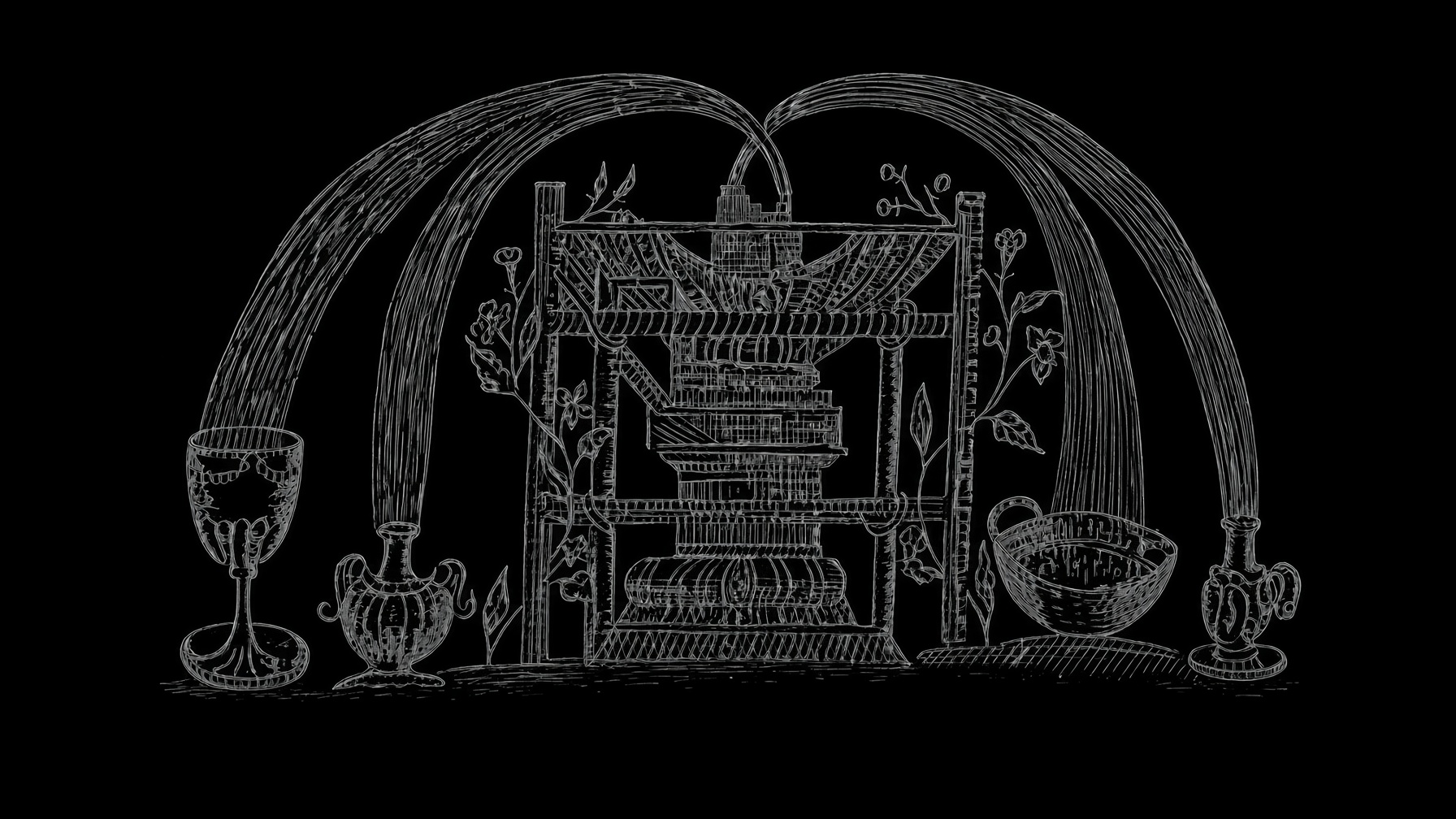
His fountain of unequal equality does not pour the same measure into every mouth. A goblet, an urn, a basket, a cup: each drinks according to its nature, and in that difference all are equal. Nothing is owed to the voice that shouts loudest. A drop is a drop.
“The fountain is unequal to all, and that is its equality.”
On the night of 6 May 2022, in the three-hundredth year of his birth, a Russian missile struck the National Literary-Memorial Museum of Hryhorii Skovoroda in Skovorodynivka. It was the house of his last years, on the ground where he is buried. Fire went through the rooms. A statue of him was lifted out of the ash and still stood; the grave nearby was spared, and the most precious papers had already been carried away. The building was not a barracks. It was a memory. To burn it was a gesture aimed at Ukrainian cultural heritage itself — an attempt to wipe a philosopher off the map, as if a ruined room could make a people forget who had taught them to know themselves. The epitaph answered first. The world tried to catch him. It did not.
About the artwork
Words appear the way vapour does — from below, with a soft light, drifting slightly as they rise. They hold for a few seconds, then thin, blur, and vanish. Nothing is kept on the screen. What remains is only the next drop, and the count of people who have touched the fountain today.
The dissolving is the point. Wisdom here is not a monument. It is a gesture: to offer one word, to let it join the others, and to watch it go.
Authors & supporters
Conceived by Stanislav Podyachev as part of the action Hospitality.
The digital object SOPHIA / Fountain of Skovoroda is a quiet companion to the table — built so that a guest with a phone, and a room with a screen, may share the same stream.
This project is a part of the section of Permanent Representation of Ukraine to the Council of Europe.